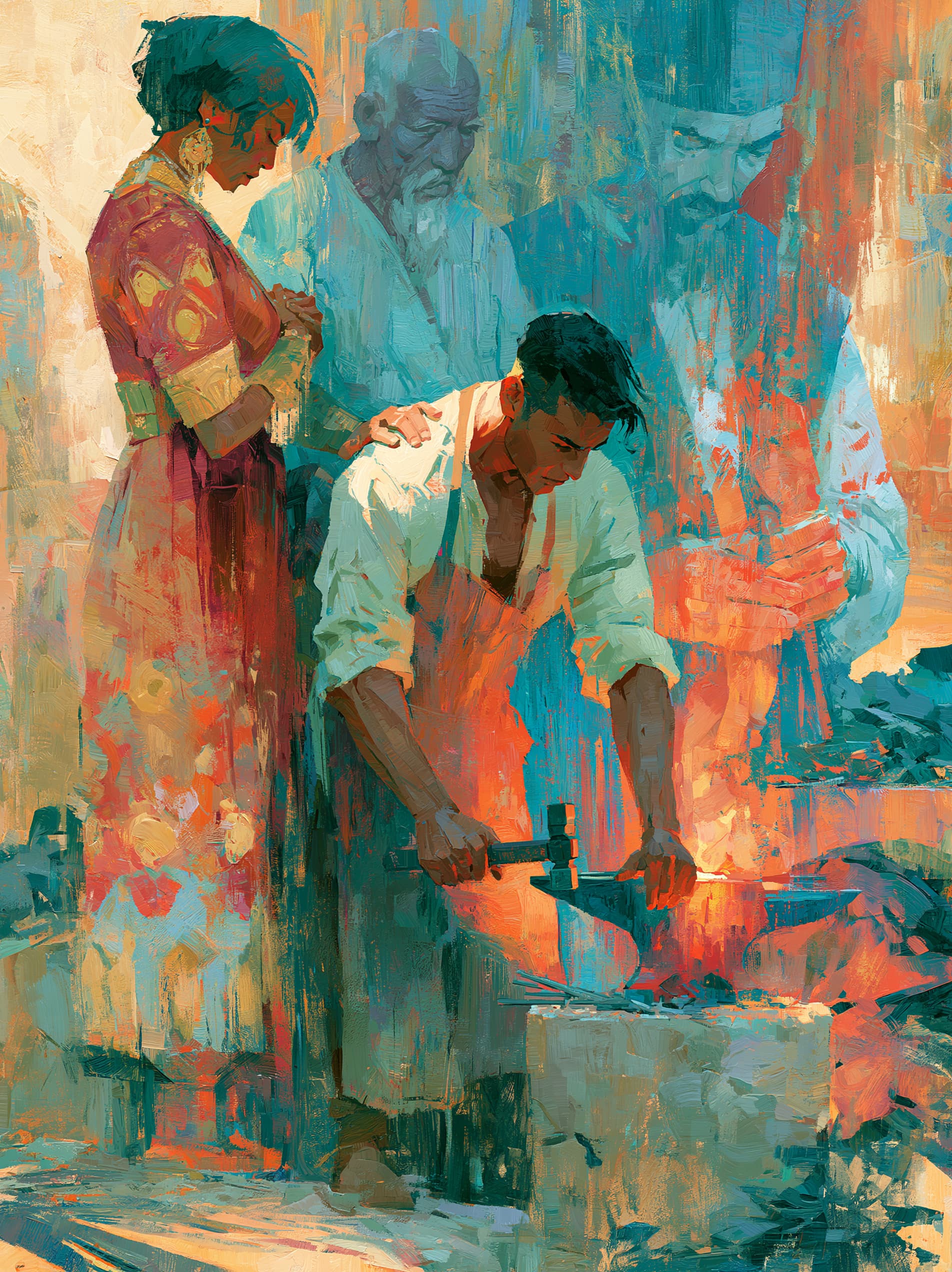
Most museums ask you to stand still. You walk a marked route, lean toward a label, read a few lines about an object resting behind glass, and move on. The object is real, but the distance is built in. You are looking at the past the way you look at a fish in an aquarium – present, but sealed off.
Open-air museums work the other way around. There is no glass. The blacksmith’s fire is lit, the loom is clacking, the bread is in the oven, and the person tending all of it will look up and talk to you. These places go by several names – living history museums, outdoor history museums, skansens – but the idea is the same: instead of preserving the artifact, they preserve the act of making it. And right now, as the country marks a major national anniversary, these institutions are getting a fresh wave of visitors who want history they can smell, hear, and touch.
A different kind of preservation
The conventional museum saves things. The open-air museum saves knowledge. That distinction matters more than it sounds, because skills disappear far more quietly than objects do. A surviving hand-forged hinge tells you something was made. It cannot tell you how the smith judged the heat by color, how he swung the hammer, or how long the whole thing took. Once the last person who knows that retires without teaching anyone, the knowledge is simply gone – no acquisition, no donation, no restoration can bring it back.
Colonial Williamsburg in Virginia has understood this for a long time. Its Historic Trades program now keeps nearly a hundred masters, journeymen, apprentices, and interpreters at work across roughly three hundred acres, practicing eighteenth-century crafts – cabinetmaking, blacksmithing, wigmaking, brickmaking, shoemaking – as a continuous chain of teaching rather than a series of demonstrations. What began as something to show tourists became one of the most serious efforts anywhere to keep pre-industrial trades alive. The reasoning is blunt: these are not quaint hobbies but irreplaceable cultural heritage, and the only way to preserve a skill is to keep doing it.
There is also evidence that the format simply teaches better. Researchers have long argued that learning by watching and doing can be dramatically more effective than learning by reading. Anyone who has watched a brickmaker work the clay, then tried it themselves, understands why a label could never deliver the same thing.
Walking into the 1830s
New England’s largest example, Old Sturbridge Village in Massachusetts, spreads more than forty historic buildings across two hundred acres along a river – houses, a country store, a district school, a meetinghouse, working farms, and water-powered mills. Visitors move on dirt paths between them, and costumed historians work the real tasks of a rural New England town as it would have looked in the early nineteenth century. You can watch carding, printing, cooking over an open hearth, or the slow rhythm of seasonal farming, from planting to harvest.
What regular visitors will tell you is that the place rewards effort. You get out of it what you put in. Walk through quickly and it is a pretty collection of old buildings. Stop, ask the weaver a question, and the century-and-a-half gap starts to close. That openness is also the format’s quiet strength: it lets the same site teach a curious eight-year-old and a serious historian on the same afternoon, each at their own depth.
Telling harder truths
The newest and most important shift in these museums is not technical. It is about whose story gets told. For a long time, living history leaned heavily on a single, comfortable narrative – usually the settlers, usually triumphant. That is changing.
Plimoth Patuxet in Massachusetts is the clearest case. The site pairs a recreated seventeenth-century English village with the Historic Patuxet Homesite, where contemporary Indigenous interpreters share the lifeways of the Wampanoag, who have lived on that land for more than twelve thousand years. Crucially, the Homesite is not staged as a frozen moment. It presents a culture that adapted and endured, and its interpreters are trained to talk openly about the long consequences of colonization – loss of land, sovereignty, and lives. The museum did not arrive here gracefully; it moved only after Wampanoag voices pushed hard, including a renaming and a major investment in new Indigenous programming. But the result is a place that asks visitors to question words like “discovery” and “settlement” rather than swallow them.
Why now
The timing is not an accident. As the United States passes a landmark anniversary of its founding, sites tied to that early history are leaning into the moment – Williamsburg marking its own century as an institution, Sturbridge running extended seasonal programming, and visitors arriving with an appetite for something more honest than a parade.
The appeal, in the end, is sensory and human. A glass case flattens the past into something you observe. An open-air museum hands it back to you as a living process – the heat of a forge, the weight of a tool, the voice of someone who has spent years learning to do a thing by hand so that the knowing does not die. That is a different kind of education, and a more durable one. You do not leave having seen history. You leave having, for an hour, lived inside it.