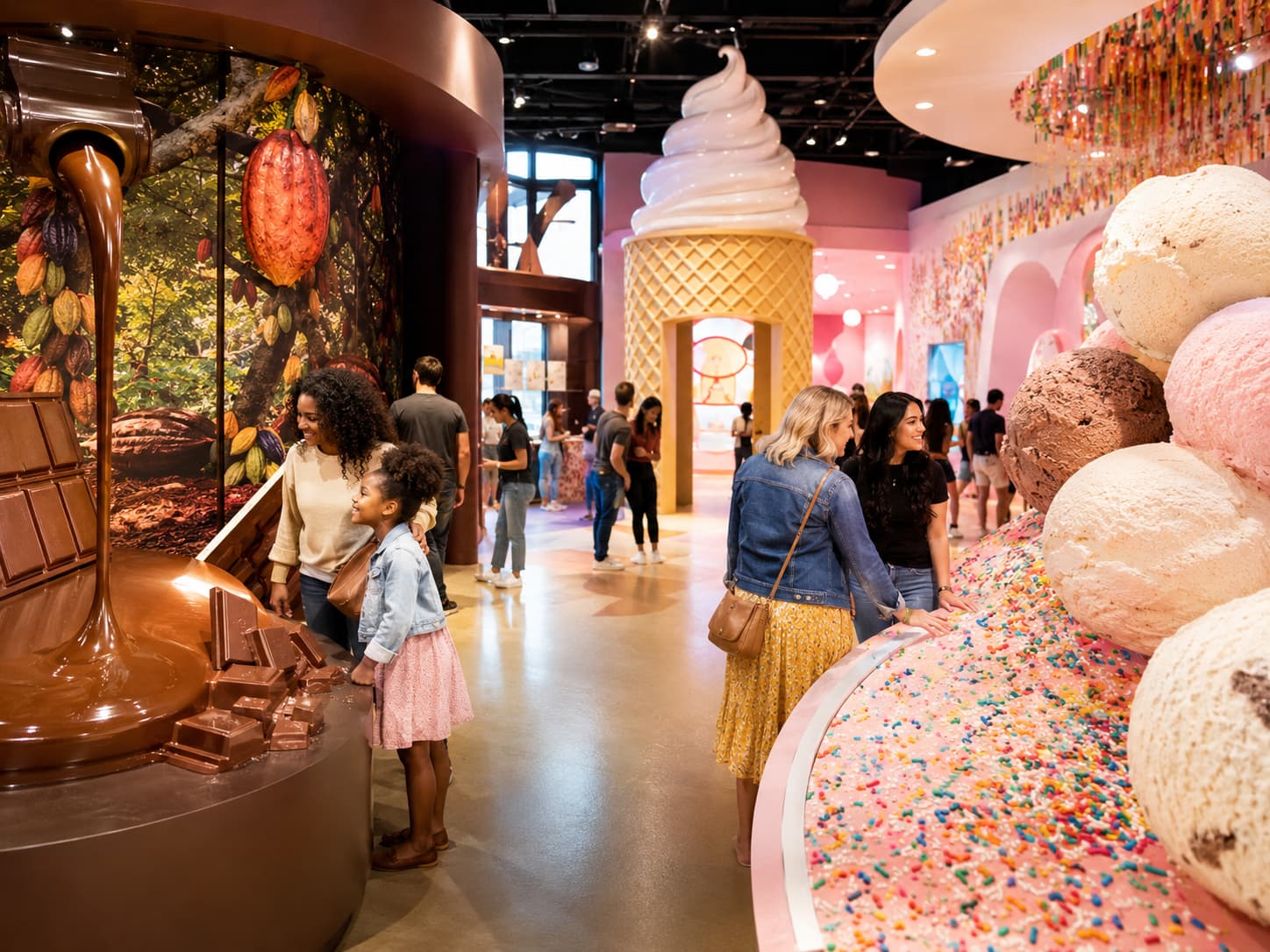
There is a particular kind of American attraction that exists somewhere between a museum, a candy store, and a theme park, and refuses to commit to any of them. You walk in expecting exhibits and leave with a sugar headache, a souvenir photo, and a vague sense that you have just been very effectively marketed to. These are the country’s food museums, and whatever you want to call them, they have become one of the more revealing corners of American leisure – places where the line between learning about something and simply consuming it has dissolved entirely.
The grandparent of the genre sits in Hershey, Pennsylvania. Hershey’s Chocolate World is not, strictly speaking, a museum. It is a free, year-round visitor center built around a single beloved ride – the Chocolate Tour – that carries you in a little car from tropical cocoa bean through a warm roaster and out past conveyor belts of twisting candy, ending, naturally, with a free sample. The aroma of cocoa hits you the moment you walk through the doors. Admission and that ride cost nothing, which is the whole strategy: the building exists to welcome you into the wider world of Hershey, and once you are inside, there is a great deal to spend money on. You can design your own candy bar on a working conveyor line, board a train-themed cinematic ride layered with projection mapping, take a trolley tour of the town, and shop the world’s largest Hershey’s store. It is brilliant, and it is unapologetically a brand experience. Even its patriotic seasonal overlays and new menu items are calibrated to give you one more reason to linger.
What Hershey understood early, and what its many successors have copied, is that food is the most generous subject a museum can choose. You cannot taste a painting. You can taste chocolate, and the tasting does half the interpretive work for you. A label explaining the roasting of cocoa is forgettable; a warm sample in your hand is not. This sensory shortcut is exactly why the format has exploded, and why it has drifted steadily away from anything resembling scholarship.
Nowhere is that drift clearer than at the Museum of Ice Cream, which began as a pop-up and grew into a multi-city sensation with locations from New York to Miami, San Francisco, and a new flagship in Las Vegas billed as its biggest yet, complete with fourteen immersive installations and a luxury “ice cream hotel” entrance. The signature feature is a pool you can dive into filled with fake sprinkles. Unlimited ice cream is handed out room to room. The institution is refreshingly honest about what it is: it tells visitors outright that it is not a traditional museum, that every installation is interactive, and that touching is encouraged. The word “museum” here is essentially decorative – a frame that lends a whiff of cultural permission to what is, at heart, a beautifully engineered photo opportunity. Visitors largely know this. The reviews that complain “this isn’t really a museum” miss the point; the ones that bring kids and a sweet tooth tend to leave delighted. It is sold as an experience, priced like an attraction, and judged best when you arrive expecting exactly that.
But it would be unfair to suggest the whole category is hollow spectacle, because some food museums take the “museum” half of their name seriously. The Spam Museum in Austin, Minnesota – a town that genuinely calls itself Spamtown USA – is the corrective example. Run by Hormel Foods and free to enter, it fills roughly fourteen thousand square feet with interactive galleries that trace the canned-meat brand from its origins through its strange and enormous global reach. There is a gallery of recipes from dozens of countries, a serious section on Spam’s role feeding troops during the Second World War, and staff cheerfully called Spambassadors handing out samples. It is funny and self-aware, but underneath the jokes is real social history: the story of a single company and the town it built, employment and philanthropy and identity all folded into the tale of a tin can. You leave actually knowing something.
That tension – between the museum that teaches and the museum that merely entertains – is the thread running through the entire genre, and it is worth noticing as a traveler. The honest move is to read each place for what it is before you go. Hershey’s Chocolate World is a free, joyful brand showcase; treat the paid attractions as optional extras and the free ride as the real draw. The Museum of Ice Cream is a premium sensory playground; bring children, lower your scholarly expectations, and you will have a fine time. The Spam Museum is the rare one that delivers genuine history wrapped in good humor, and it costs nothing.
What unites all of them is a very American instinct: the belief that the best way to celebrate something is to let you eat it. These places are not really about chocolate or ice cream or canned pork at all. They are about the pleasure of being immersed, indulged, and sent home a little stickier than you arrived – and on that promise, at least, they deliver every time.